Decide what you can document before discussing a sale
When considering a sale of electrical distribution equipment in Pennsylvania, begin by separating what you can identify from what remains unknown. For each breaker or assembly, record the pole count and the voltage markings as distinct details. A pole count describes one aspect of the equipment; a voltage marking describes another. Neither detail alone establishes that a breaker is suitable for a particular installation or interchangeable with another unit. Clear separation helps a buyer assess the equipment without relying on guesses.
Share only information you already have access to and can report accurately. Markings visible in existing records or safely accessible views may help; photos and labels are optional. You do not need to test, energize, open, adjust, disconnect, dismantle, or handle equipment to prepare an inquiry. If a marking is missing, unclear, or unavailable, identify it as unknown rather than supplying an estimate. The seller controls access to the equipment and decides what information is available for review.
Keep pole count and voltage markings separate
Describe pole count as its own recorded identifier, using the wording shown in existing documentation or on a label you can already see. Do not use pole count to infer voltage, application, compatibility, or the condition of a breaker. Equipment that appears similar in one respect may differ in other identifying details, and a count by itself does not settle those questions. Where records and visible markings differ, report both observations and explain which source each came from.
Record voltage markings independently and preserve the wording as closely as possible. A marked value is an identification detail, not proof that another item with a similar marking can replace the breaker or serve the same purpose. Avoid converting, interpreting, or filling in incomplete markings. If there is no legible voltage information available, say that the marking is unknown. This gives a buyer a more useful basis for discussing the equipment than an unsupported conclusion about its rating or intended use.
Describe uncertainty without turning it into a rating
Equipment inventories often contain gaps: a label may be unreadable in an existing image, paperwork may cover only part of an assembly, or pole count may be recorded without voltage markings. Keep those gaps visible in the description. Separate confirmed identifiers from details that are unavailable, and distinguish a direct observation from information copied from records. This helps prevent a tentative note from being mistaken for a confirmed equipment characteristic during buyer review.
Do not infer interchangeable use from matching pole counts or similar voltage markings, and do not present identifiers as confirmation of local electrical code compliance. Those conclusions require information beyond the two details being recorded. For a sale discussion, it is more accurate to state what the inventory shows and what it leaves unresolved. Buyers can then consider the equipment and available records as a whole, with no need for the seller to manufacture certainty or perform technical checks.
Organize the equipment and its records
For a group of breakers, keep identifiers tied to the individual items or assemblies they describe. A general note such as “same poles” may not make clear which units it covers, while a shared voltage entry may be difficult to interpret if the inventory does not identify its scope. Use descriptions that connect each available pole count and voltage marking to the corresponding equipment. Where several items are grouped for discussion, explain which details apply to the group and which are known only for particular pieces.
Keep the scope of any records clear as well. An inventory, document, or existing photo might cover an individual breaker, part of a lineup, or a larger equipment group. State the scope you know; do not imply that every component has been individually identified when the information does not establish that. This distinction supports a more productive review of surplus or decommissioned equipment while keeping unverified details separate from documented facts.
Discuss the equipment as a sale, not a compatibility decision
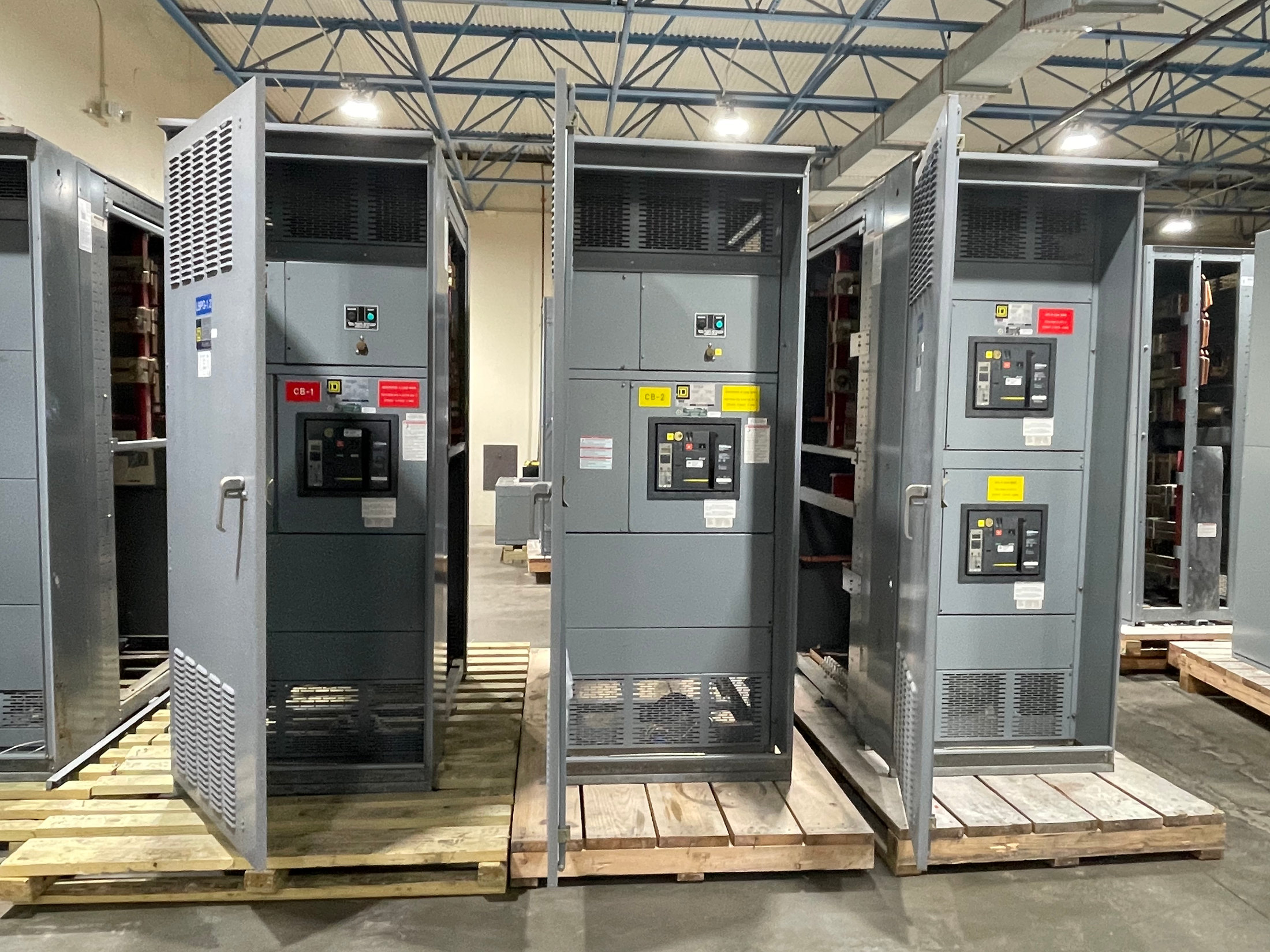
We are an independent Pennsylvania buyer of used, surplus, and decommissioned electrical distribution equipment, and we buy only. We consider switchgear from decommissioned data centers and shut-down power plants across all voltage classes. Pole counts and voltage markings can help describe equipment being offered, but they are not a promise of interchangeable use, a conclusion about compliance, or a substitute for identifying the broader equipment and sale scope. Whether an offer is possible depends on the equipment and the information available; not every item will receive an offer.
Our process does not require seller testing. Share the known inventory details and identify unknowns; there is no need to test or energize equipment to prepare the sale discussion. We make cash offers for equipment we agree to buy, with payment upfront before pickup. The offer and sale depend on the equipment and agreement between the parties. A listing of identifiers is useful for review, but it does not by itself establish that a purchase will proceed.
Coordinate access, pickup, and logistics
If a sale is agreed, we handle cranes, rigging, disconnects, loading, freight, and hauling. Coordinate the equipment scope and access arrangements with us before pickup so that the logistics can be discussed in relation to what is being sold. Sellers remain in control of access to their site and equipment. No seller testing, opening, dismantling, or physical handling is needed to describe pole counts or voltage markings for an initial inquiry.
Keep logistics information distinct from electrical identifiers. The number of poles and any voltage marking help describe the equipment; they do not establish pickup conditions or define the full equipment scope. Report known inventory boundaries and access considerations separately, and flag details that are not yet confirmed. This gives both parties a clearer basis for discussing a potential purchase, payment before pickup, and the coordinated removal of equipment if an agreement is reached.
Cross-reference rating topics without conflating identifiers
When an inventory includes other rating information, keep each recorded field distinct rather than using pole count or voltage markings as a stand-in for it. Related rating topics can be reviewed through their existing rating pages, while this discussion remains focused on breaker poles and voltage markings as seller-identification details. That separation makes it easier to see which facts are known, which are missing, and which records apply to a particular item or group.
A concise, accurate description can state the pole count, reproduce any available voltage marking, name the source of each detail, and label unresolved information as unknown. It should not extend those observations into claims about compatibility, code compliance, or intended installation. With that distinction in place, buyers can review the offered equipment on its actual documented information and discuss whether a purchase makes sense.